The increased need of the train to be faster and the axle to carry more weight has led to the necessity of different measures to be taken in relation to the safety of railway bridges and in order that they could remain trustworthy i.e. the use of IoT in bridge monitoring and the mounting of sensors on railway bridges. As a result, a large number of railway bridges that span the length and breadth of India are very old and have to be tested for their use under contemporary operational conditions.
Through IoT Bridge Monitoring, sensors record stress, deflection, vibration, and tilt in real time, creating a digital foundation for bridge safety management. This case study explains how Sensor Installation on Railway Bridges supports continuous monitoring and fatigue-life prediction, thereby improving safety and extending structural service life.
Objectives
The objective of this project was to implement a comprehensive IoT Bridge Monitoring solution through Sensor Installation on Railway Bridges to measure structural behavior under live train loads.
1. Capturing strain, deflection, acceleration, and tilt using IoT-based sensors
2. Validating analytical models and confirming bridge response accuracy
3. Assessing fatigue damage and estimating residual life using live data
4. Establishing continuous digital tracking through IoT Bridge Monitoring for predictive maintenance
5. Enhancing decision-making for engineers and maintenance authorities.
Bridge Overview
The chosen bridge structure for sensor installation on railway bridges was a three-span steel plate girder bridge, with each span being 18.3 meters long.
1. Material: Fe 410 structural steel
2. Built Year: 1960s
3. Operating Load: 25 T axle load configuration
4. Speed Range: 20 to 100 km/h
5. Monitoring Duration: 3 months, continuous logging
Instrumentation Methodology
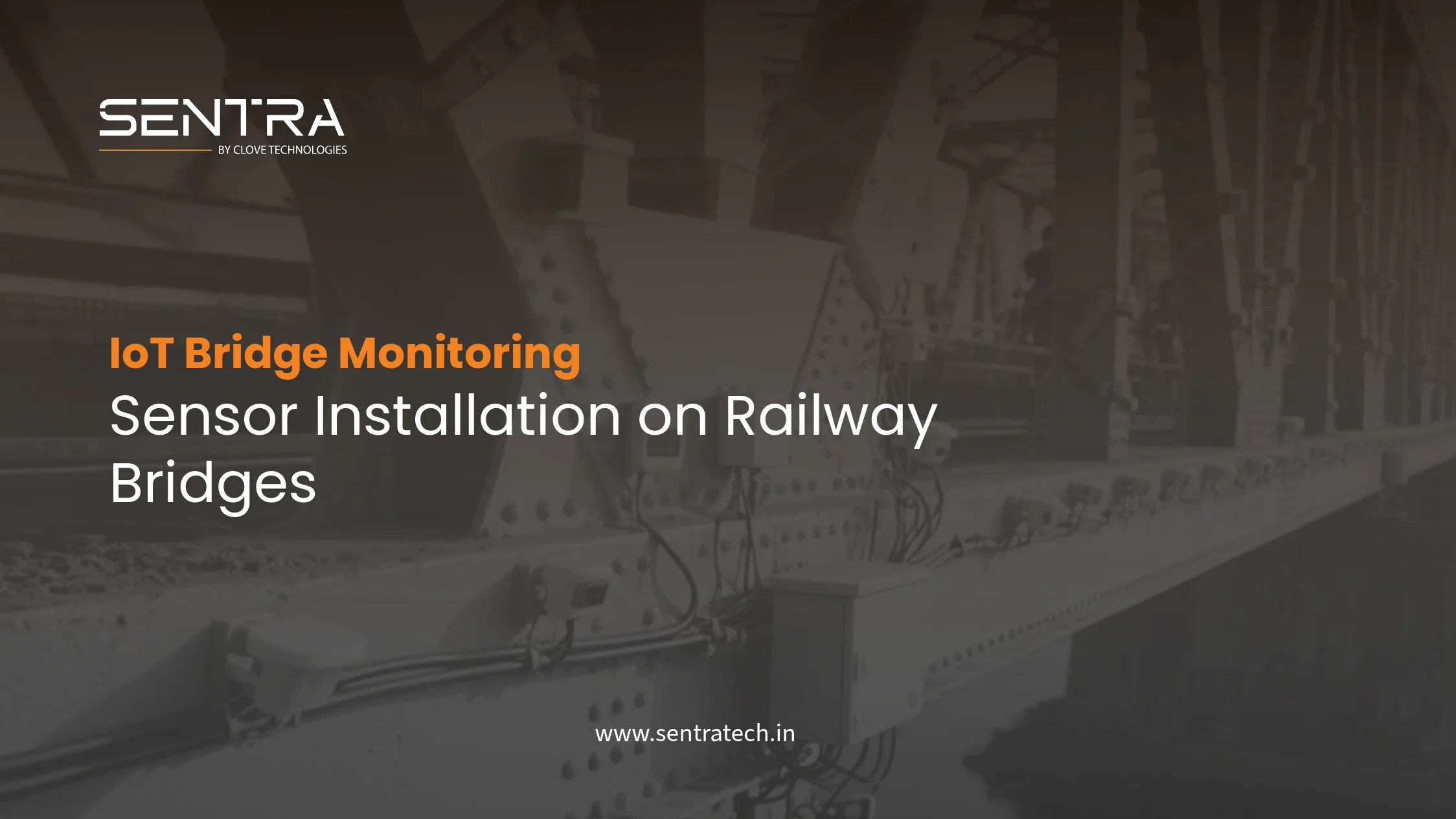
Sensor LocationsDuring Sensor Installation on Railway Bridges, the sensors were placed at critical stress points to ensure accurate and representative data collection.
| Location | Sensor Type | Monitoring Purpose |
|---|---|---|
Bottom flange of main girders (mid-span) |
Strain gauges |
Measure stress and bending under train loads |
Cross girders near bearings |
Strain gauges |
Assess load transfer and secondary stresses |
Mid-span |
LVDTs |
Capture deflection and serviceability behavior |
Bearings and piers |
Inclinometers |
Detect tilt or settlement in substructure |
Deck and expansion joints |
Accelerometers |
Analyze vibration amplitude and frequency |
Girder surface |
Temperature sensors |
Compensate for thermal effects |
A multi-channel IoT Bridge Monitoring data acquisition unit (DAQ) was configured with synchronized inputs from all sensors. The system recorded strain, vibration, and deflection at a sampling rate of 100 Hz and transmitted data wirelessly to a cloud platform. Through IoT Bridge Monitoring dashboards, engineers could observe real-time bridge behavior, set alarm thresholds, and analyze trends remotely, ensuring uninterrupted monitoring during live operations.
Testing and Monitoring Process
1. Baseline Measurements: Geometry, camber, and bearing conditions were surveyed before instrumentation.
2. Calibration Tests: Controlled train runs established reference stress and deflection profiles.
3. Dynamic Load Monitoring: Continuous recording under operational train speeds between 20 and 100 km/h.
4. Cloud Data Logging: Automated, timestamped readings through the IoT Bridge Monitoring platform.
5. Validation: Field data correlated closely with design model predictions, confirming system accuracy.
The real-time insights from Sensor Installation on Railway Bridges allowed early identification of load effects and dynamic behavior deviations.
Data Analysis and Results
Stress and Fatigue Performance1. Peak Stress Range: 98 MPa at mid-span under full train load.
2. Mean Stress: 72 MPa.
3. Fatigue Damage Index: 0.63 (within safe limits).
4. Residual Fatigue Life: 12 to 15 years estimated from stress range spectra.
1. Maximum Deflection: 6.2 mm (within serviceability limit).
2. Natural Frequency: 5.3 Hz, used to confirm the structure is stiff enough.
3. Damping Ratio: 0.04, which matches the standard range for steel bridges.
Tilt readings from piers and bearings showed no abnormal displacement, validating foundation stability. The IoT Bridge Monitoring system automatically flagged deviations exceeding permissible values.
Results Summary
| Parameter | Measured Value | Limit | Result |
|---|---|---|---|
Stress Range | 98 MPa | 120 MPa | Safe |
Deflection | 6.2 mm | 7.5 mm | Within Limit |
Frequency | 5.3 Hz | ≥ 4.5 Hz | Acceptable |
Fatigue Index | 0.63 | < 1.0 | Healthy |
1. Peak Stress Range: 98 MPa at mid-span under full train load.
2. The analysis confirmed that Sensor Installation on Railway Bridges provided reliable and accurate data for validating bridge design and ensuring operational safety.
3. Through IoT Bridge Monitoring, maintenance teams now receive actionable data insights for proactive interventions.
4. Residual Fatigue Life: stress range spectra have yielded an estimate of 12 to 15 years.
1. Setting up an IoT system for Bridge Monitoring ensures perpetual awareness of the bridge condition which is a direct change from the usual manual inspections that are done periodically.
2. Sensor Installation on Railway Bridges enhances precision in detecting stress anomalies and fatigue cycles.
3. Real-time dashboards enable data-based maintenance scheduling and resource optimization.
4. Long-term sensor networks should be standardized for all critical railway bridges.
- 24x7 visibility of structural performance.
- Early fault detection reduces inspection costs by up to 40%.
- Improved reliability for higher-speed and heavier freight operations.
- Objective, data-driven decision-making for maintenance planning.
- Safer and more sustainable railway bridge network.
The success of this project proves that IoT Bridge Monitoring is not just a diagnostic tool but a strategic asset for infrastructure resilience.
Conclusion: Advance Railway Safety with IoT Bridge Monitoring
The amalgamation of Sensor Installation on Railway Bridges with IoT Bridge Monitoring is a significant step forward in the management of railway infrastructure. It is these systems that, by providing continuous, ultra-precise data on stress, deflection, vibration, and fatigue, enable engineers and officials to decide on maintenance interventions based on evidence.
Interested in IoT Bridge Monitoring?
Let's discuss how sensor installation and real-time monitoring can transform your railway infrastructure safety.
Contact us