
Wireless Vibration Meter
A high-precision tri-axial vibration sensor for automated, long-term structural and ground vibration monitoring. Features configurable PPV and MTVV operational modes with edge-based threshold detection and up to 2 years of battery life.
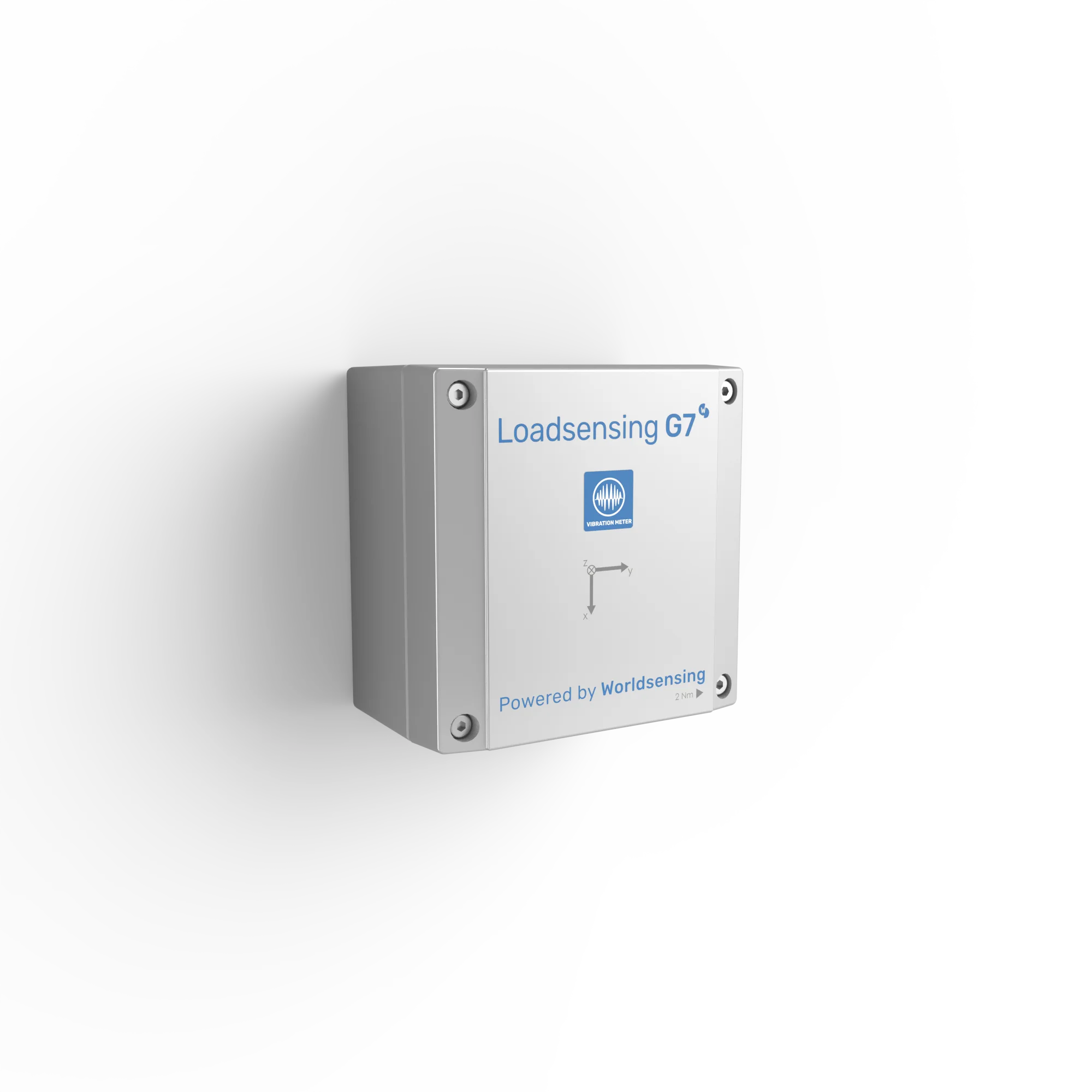
Vibration Meter
Model: LSG7ACL-BILR-VIB
Internal AntennaAutomated Vibration Monitoring for Infrastructure Safety
The Wireless Vibration Meter is a tri-axial sensor built for long-term, continuous vibration monitoring of bridges, tunnels, buildings, and industrial assets. It leverages an exception-based edge algorithm that automatically detects and reports threshold breaches based on PPV and frequency parameters.
Available with internal antenna (Vibration-IR) for compact, streamlined deployment in general assessment applications.
PPV-based & MTVV-based operation
Automatic threshold breach alerts
Waveform capture for post-event analysis
Wireless configuration via Worldsensing App
Two Powerful Analysis Modes
Configurable operational modes with advanced algorithms for various vibration standards and assessment requirements. Available with internal antenna for compact deployment.
PPV-Based Mode
Reports Peak Particle Velocity (PPVx,y,z in mm/s), frequency (fx,y,z in Hz), temperature (ºC), and Peak Vector Sum (PVS). Velocity range: 0-60 mm/s (±0.01 mm/s). Frequency output range: 1-100 Hz (±0.5 Hz). Ideal for blast vibration monitoring and structural response assessment.
MTVV-Based Mode
Reports maximum transient vibration value (LAW-x,y,z in dBm) and temperature (ºC). Acceleration range: ±2g. Frequency weighting: Wm. Designed for human comfort assessment and continuous vibration monitoring per ISO standards.
Alert mode with secondary threshold enables automatic reporting of critical events via real-time notifications.
What Makes the Vibration Meter Different
Purpose-built for automated structural and ground vibration monitoring with edge intelligence and long-range wireless connectivity.
High-Precision MEMS
3-axis MEMS accelerometer with 22.5 μg/√Hz noise floor (XHP). 1000 Hz sampling derived from 4 kHz signal for accurate vibration measurement across 0.5-250 Hz frequency band.
Long Battery Life
Up to 2 years of unattended operation on a single 3.6V D-size replaceable battery. Optimized power management with configurable reporting intervals from 10 minutes to 6 hours.
IP68 Rated & Rugged
Industrial-grade IP68 enclosure for full submersion protection. Operating range from −40°C to +80°C — suitable for the harshest field conditions.
Edge Algorithm
Exception-based detection automatically identifies threshold breaches based on PPV/LAW and frequency parameters, eliminating manual data retrieval and reducing false alarms.
Cloud & Edge Management
Configure locally via CMT Edge for single-network deployments, or connect to CMT Cloud for multi-project, multi-network oversight from anywhere.
Mobile App Configuration
Wireless Bluetooth setup via Worldsensing App. Includes integrated temperature and humidity sensors for comprehensive environmental monitoring.
Vibration Monitoring for Every Environment
Explore the wide range of monitoring applications the Vibration Meter enables across structural, geotechnical, and industrial environments.
Structural Monitoring
Bridge Vibration
Continuous monitoring of bridge response to traffic loads, wind, and environmental factors. Detect structural fatigue and assess remaining service life.
Tunnel Lining
Monitor tunnel lining response to nearby construction, blasting, and ground settlement with high-frequency vibration analysis.
Building Safety
Assess structural response to construction activities, pile driving, and demolition. Ensure compliance with vibration standards and protect neighboring assets.
Railway Vibration
Monitor ground-borne vibration from rail traffic to assess human comfort and structural impact on adjacent buildings and infrastructure.
Construction & Industrial
Blast Monitoring
PPV-based operation for blast vibration monitoring in mining and construction. Ensure compliance with regulatory limits and prevent structural damage.
Machinery Health
Monitor industrial machinery vibration for predictive maintenance and early detection of bearing faults, imbalance, and misalignment.
Pile Driving
Real-time vibration monitoring during pile driving and sheet piling operations to protect adjacent structures and maintain compliance.
Human Comfort
MTVV-based monitoring with Wm frequency weighting for assessment of human exposure to vibration in buildings and transport environments.
Vibration Meter Specifications
| Sensor Type | 3-axis MEMS accelerometer |
|---|---|
| Operation Modes | PPV-based and MTVV-based |
| Sampling Rate | 1000 Hz derived from a 4 kHz signal |
| Noise Floor | 22.5 μg/√Hz (XHP) • 75 μg/√Hz (IR) |
| Frequency Band | 0.5 – 250 Hz |
| Power Source | 1 × 3.6 V D-size replaceable battery |
| Operating Temperature | −40°C to +80°C |
| Weather Protection | IP68 |
| Data Transmission | LoRa radio communications (ISM sub GHz) |
| Detailed Specifications | ||||||||||||||||||||||||||||||
|
PPV Range: 0-60 mm/s
Accel Range: ±2g
Temp: −40°C to +80°C
|
At 30 min reporting:
SF9 2 yrs
SF11 1.4 yrs
|
||||||||||||||||||||||||||||||
Need the full technical details?
Complete specs, diagrams, and compatibility info
Flexible Mounting for Any Environment
Choose the mounting configuration that best fits your deployment site.
Pole Mounting
Using aluminum plate WS-ACC-POLE-PL8 with 35 mm or 50 mm u-bolts for secure attachment to poles and posts.
Wall Mounting
Using external mounting brackets LS-ACC-MEC-MP (set of 2) for secure wall installation in tunnels and structures.
Horizontal & Surface Mounting
Using versatile plate LS-ACC-IN15-HP for horizontal and vertical surface deployment.
Got Questions About the Vibration Meter?
Can't find what you're looking for? Contact our team — we're happy to help.
It's a wireless tri-axial sensor for continuous vibration monitoring of structures like bridges, tunnels, railways, and buildings — helping detect vibration events, assess structural health, and ensure safety compliance.
The sensor uses a 3-axis MEMS accelerometer with an edge algorithm that identifies threshold breaches based on PPV/LAW and frequency, ensuring only critical vibration data is reported.
It supports LoRaWAN for long-range, low-power communication — up to 15 km range in open terrain. Configuration via Worldsensing App (Bluetooth) or remotely via CMT Edge and CMT Cloud.
With its ultra-low-power design, the replaceable D-size battery lasts up to 2 years under normal operation (30 min reporting, SF9), ensuring reliable long-term deployment.
PPV-based mode reports Peak Particle Velocity and frequency for blast and structural monitoring. MTVV-based mode computes maximum transient vibration values with Wm frequency weighting for human comfort assessment.
It can be installed on bridges, tunnels, buildings, industrial machinery, and construction sites — including underground or hard-to-reach locations, providing continuous vibration insights.