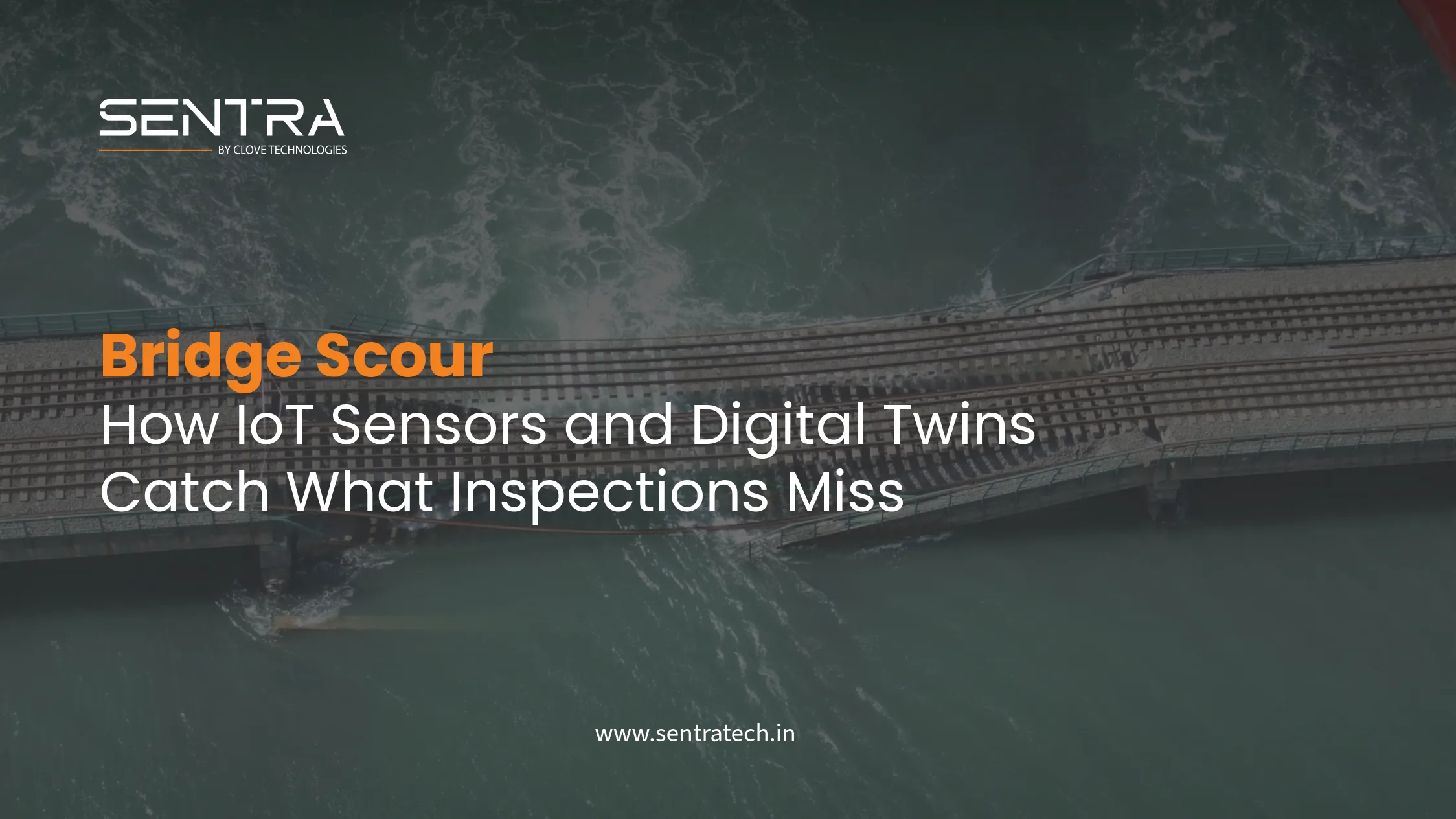
A bridge that fails from scour usually looks fine the week before. The deck is level, the parapets are straight, and the last inspection report came back clean. What changed sits three or four metres underwater, where flood flow has been quietly carrying away the sand and gravel that the foundation was relying on.
This is why scour is treated so seriously in bridge asset management, and why it is such an uncomfortable problem to inspect. The mechanism is well understood. The timing is not.
What scour actually is
Scour is the removal of streambed material by moving water. Engineers usually separate it into three components that add together at any given pier:
- General scour: Long-term lowering of the riverbed across the whole channel, driven by changes in sediment supply, upstream dams, or sand mining. It happens over years and is unrelated to the bridge itself.
- Contraction scour: Where the bridge narrows the channel, the water speeds up and lifts more sediment than it deposits. Embankments and approach fills make this worse.
- Local scour: The hole that forms directly around a pier or abutment. Flow hits the obstruction, rolls down its face, and forms a horseshoe vortex at the base that drills into the bed.
Local scour is normally the deepest and the fastest, and it is the one that undermines a foundation. Under a large flood it can develop in hours.
Why routine inspection misses it
Here is the part that surprises people outside the industry. Scour holes tend to refill.
During the flood peak, flow velocity is high enough to keep sediment suspended and the hole opens up around the pier. As the flood recedes, velocity drops, and that same sediment settles back into the hole. By the time the water is calm enough for a diver or a survey boat, the bed can look close to normal. The material sitting in the hole is loose, poorly compacted backfill, and it offers a fraction of the lateral support the original bed did, but it reads as solid ground on a probe.
Stack the practical constraints on top of that:
- Inspection intervals are long. Routine bridge inspections are typically scheduled on a multi-year cycle, and underwater inspections are usually less frequent still. A flood can come and go many times between visits.
- Visibility is often zero. In silty or fast water, divers work by feel. Measuring the depth and shape of a hole by hand, against a current, is slow and imprecise.
- Nobody inspects during the flood. The moment you most want a reading is the moment it is least safe to get one.
So the inspection regime is well designed for things that change slowly, such as concrete deterioration and bearing wear, and poorly matched to something that appears and disappears within a single storm.
What continuous monitoring measures instead
Instrumentation approaches the problem from two directions. One set of sensors watches the riverbed. The other watches how the structure is responding, which matters because a pier that has lost support behaves differently even before anything visible happens.
On the bed side:
- Fixed sonar and echo sounders: Mounted on the pier face and aimed at the bed, these measure the distance to the sediment surface on a set interval. They record the hole opening during the flood and the backfill arriving afterwards, which is exactly the history a post-event inspection cannot recover.
- Magnetic sliding collars: A collar sits on the bed around a rod driven into it. As the bed erodes, the collar drops and its position is registered. Mechanically simple and hard to fool, though it only records the maximum reached.
- Float-out devices: Buried at a known depth, these release and transmit when scour reaches them. They act as a threshold alarm rather than a continuous reading.
- Water level and velocity sensors: Stage and flow data give the hydraulic context. Scour depth on its own is a number. Scour depth alongside the flood hydrograph tells you how the structure responds to a given discharge.
On the structural side:
- Tiltmeters: A pier losing support on one side rotates before it settles visibly. High-resolution tiltmeters resolve movements far below what a level survey would pick up, and they run continuously.
- Accelerometers: Foundation stiffness shows up in the dynamic response. As the bed around a pier erodes, the effective fixity of the foundation changes and natural frequencies drift downward. Tracking that shift with accelerometers gives an independent signal that does not depend on seeing the bed at all.
- Strain gauges: Load redistributing between piers after one loses support changes the strain pattern. Strain measurement at instrumented sections helps confirm where that load has gone.
The structural sensors are useful for a second reason. They keep working when the bed sensors are buried, damaged by debris, or fouled.
Getting data off a river in flood
Bridge sites are rarely convenient. Many are far from mains power, and the ones that need scour monitoring most are often the remote river crossings. A workable installation has to survive without site visits for long stretches.
- Power: Solar with battery backup sized for the worst part of the year, including the monsoon weeks when the panel sees very little sun and the site is generating the most interesting data.
- Communications: Cellular where coverage allows, with LoRaWAN or radio backhaul to a gateway at a better-connected location where it does not.
- Adaptive sampling: Reading every few hours in dry weather and every few minutes once water level crosses a trigger. This keeps power and data costs down without losing resolution during the event that matters.
- Local logging: A data logger that buffers on site means a dropped connection during a storm costs you transmission, not the record.
Physical protection deserves attention too. Anything mounted on the upstream face of a pier during a flood will be hit by logs, plastic, and whatever else the river is carrying.
Where the digital twin earns its place
A sensor tells you the bed dropped by 900 mm. It does not tell you whether that matters for this particular pier, on this foundation, in this soil.
That judgement needs the structure's own model: pile depths, footing geometry, soil profile, and the design assumptions about embedment. A digital twin holds those alongside the live sensor feed, so a scour reading can be evaluated against the remaining embedment and the capacity that depends on it rather than against a generic limit.
That combination supports a few things that raw readings do not:
- Thresholds specific to the asset. The depth that should trigger a closure on a shallow spread footing is not the depth that should trigger one on long piles. The model sets the number.
- Comparison against prediction. Design scour depths come from empirical equations that are known to be conservative in some conditions and not others. Years of measured data against predicted values tells you how your bridges actually behave.
- Portfolio ranking. An owner with hundreds of crossings cannot instrument all of them. Measured behaviour at a representative sample informs which of the rest deserve attention first.
- A record that survives the flood. Cumulative scour history matters because repeated cycles of erosion and loose backfill degrade support over time even when no single event looks severe.
Acting on the data during an event
The operational value shows up in the middle of a storm, when someone has to decide whether to keep a road open.
Without instrumentation that decision rests on rainfall forecasts, upstream gauge readings, and experience. Those are reasonable inputs, but they describe the river rather than the bridge. With scour and tilt data streaming, the question shifts from whether the flood looks bad to whether this structure is actually moving.
Sensible alerting is tiered. An early notice when scour passes a watch level and the water is still rising. A second when it approaches the depth the model flags as significant for the foundation. An immediate escalation if tilt or frequency data indicate the pier is responding, since that means the structure has already felt the loss of support.
After the water drops, the same record tells the inspection team where to concentrate, and how much to trust what they find on the bed.
Retrofitting an existing bridge
Most bridges that need this were built long before anyone considered instrumenting them, and many predate reliable records of what is under the water line.
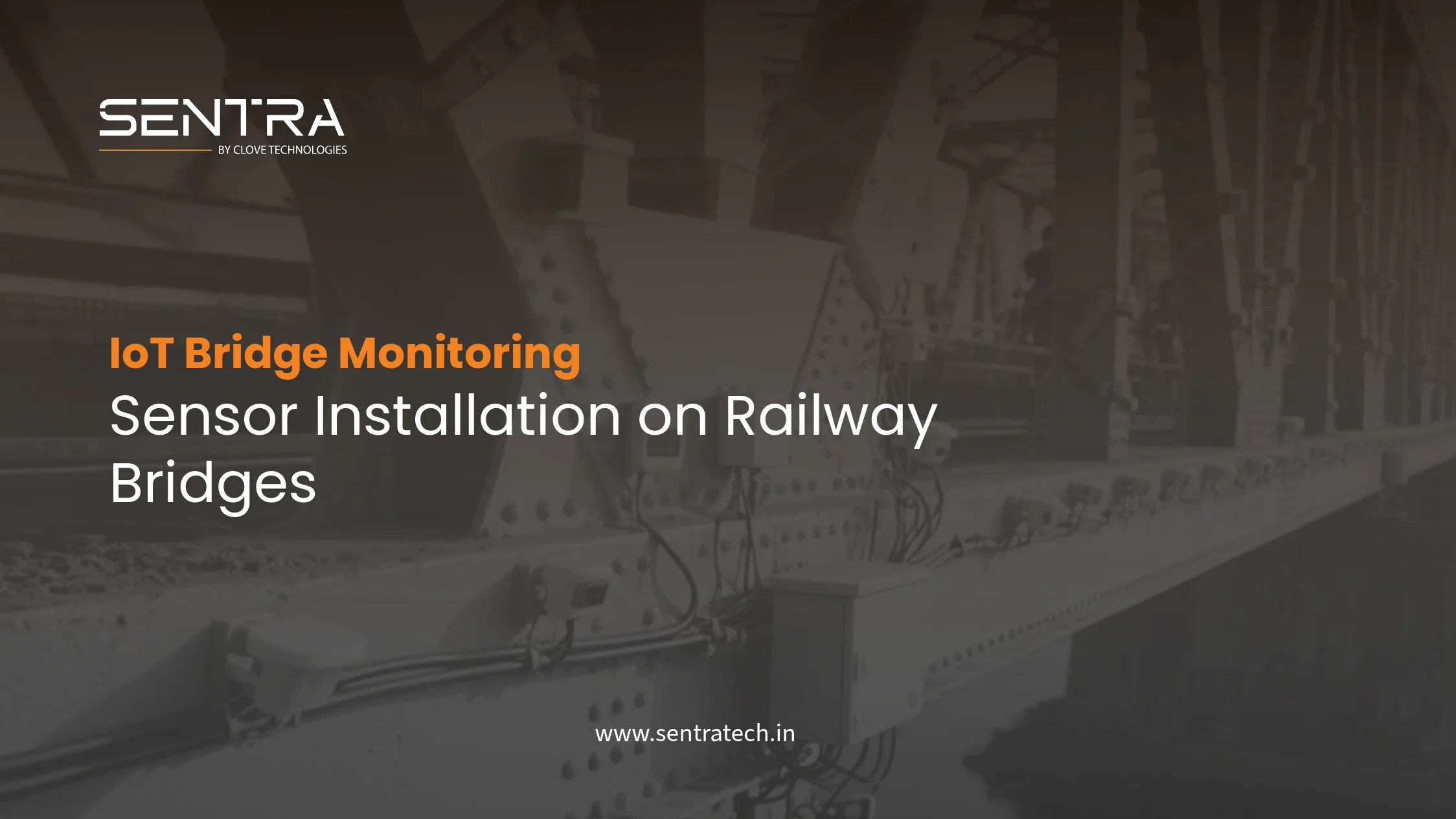
Wireless sensor networks make retrofit practical. Nodes attach to pier faces and abutments without structural modification, run on battery or solar, and report to a gateway. The awkward part is usually access for installation rather than the technology, so the work is best scheduled for a low-flow season.
One thing worth planning for: a baseline. Scour monitoring compares against a known bed level, so an accurate bathymetric survey at installation is what makes every later reading meaningful. Instrumenting a bridge without establishing that starting point gives you trends without a reference. For crossings where the foundation records are missing altogether, pairing the sensors with geotechnical and foundation investigation is worth doing first.
Scour monitoring also fits naturally alongside broader structural health monitoring on the same crossing, since the accelerometers and tiltmeters serve both purposes. If you are weighing up which of your structures need continuous monitoring at all, our note on early warning signs for bridge monitoring covers the wider set of indicators, and the guide to hidden structural damage looks at the defects that visual inspection tends to miss above the waterline.
Know what your riverbed is doing
Sentra installs and operates scour and structural monitoring on river crossings, including remote sites without power or reliable coverage. If you are responsible for bridges over water and want to know how they behave during a flood rather than weeks afterwards, we can help you work out what to measure and where to start.
Contact us