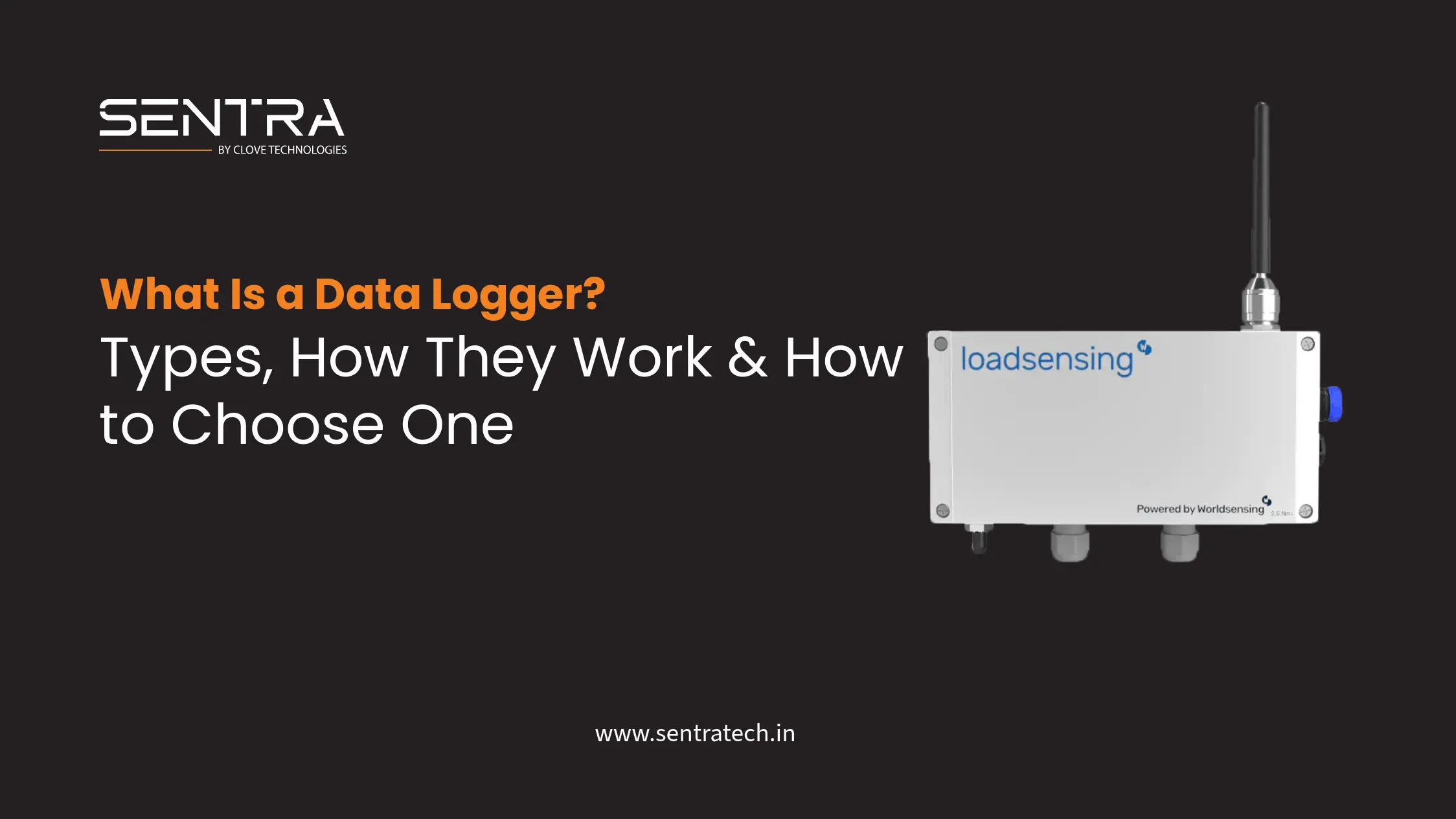
A data logger is an electronic device that records measurements from one or more sensors over time, typically with a timestamp attached to every reading, so the data can be analysed as a trend rather than a single snapshot. In its simplest historical form that meant an instrument you'd deploy, leave running, and physically retrieve weeks later to download the stored readings. In a modern monitoring system, it's evolved into something closer to a small, purpose-built computer that samples, processes and transmits data continuously, without anyone needing to visit the site.
How a Data Logger Works
At its core, a data logger performs three jobs: it samples one or more connected sensors at a set interval, converts the raw signal, whether that's a resistance change, a frequency, a voltage or a digital protocol, into an engineering value, and stores or transmits that value with a timestamp. Onboard memory provides a buffer if connectivity drops, while a radio module, LoRaWAN, cellular, Wi-Fi or satellite, handles getting the data off-site to a server or cloud platform for storage and analysis.
Types of Data Loggers
Temperature data loggers
Single-purpose loggers built around a temperature probe or thermocouple, common in cold-chain, HVAC and environmental applications.
Analog data loggers
Multi-channel loggers that accept a range of analog sensor inputs (4-20mA, 0-5V, thermocouples, RTDs), giving flexibility to connect different sensor types to one unit.
Vibrating wire data loggers
Purpose-built to excite and read vibrating wire sensors, strain gauges, piezometers, extensometers, converting their frequency output into calibrated engineering units. This is the class Sentra's G7 vibrating wire data logger belongs to.
Wireless IoT data loggers
Combine sensor sampling with built-in LoRaWAN, cellular or satellite connectivity, streaming data continuously to a cloud platform rather than storing it locally for manual download. This is the category most infrastructure and remote-site monitoring has moved to.
Data Logger vs Real-Time IoT Telemetry
The term "data logger" carries some historical baggage: it can still imply a standalone device that stores readings locally until someone retrieves it in person, fine for a short research deployment, impractical for a bridge, dam or rail corridor that needs continuous, unattended visibility. Modern connected data loggers close that gap entirely, sampling on the same schedule a legacy logger would, but pushing every reading to the cloud in near real time over LoRaWAN or cellular, with local memory kept only as a buffer in case of a connectivity gap. The result is the reliability of a logger with the immediacy of live telemetry.
What to Look For When Choosing a Data Logger
- Channel count & sensor compatibility: how many sensors, and what types, it can read simultaneously.
- Connectivity: LoRaWAN for long battery life and range, cellular for sites without a gateway, satellite for the most remote deployments.
- Battery life: multi-year, field-replaceable batteries matter enormously for unattended infrastructure sites.
- Environmental rating: IP68 and a wide operating temperature range for exposed outdoor installations.
- Cloud & software integration: whether the logger feeds directly into a dashboard and alerting platform, or requires a separate integration project.
Takeaway
A data logger's job hasn't changed, sample, timestamp, deliver, but the best modern loggers do it continuously and wirelessly, closing the gap between “logged data” and real-time telemetry.
Explore Sentra Data LoggersFrequently Asked Questions
A data logger is used to automatically record sensor readings over time, temperature, strain, tilt, vibration or other measurements, with a timestamp on every value, so that data can be analysed as a trend rather than captured manually at isolated points in time.
A sensor detects a physical quantity, such as strain, temperature or tilt, and produces a raw signal. A data logger is the device that samples that signal at set intervals, converts it into an engineering value, timestamps it, and stores or transmits it, often across multiple sensors connected to the same unit.
It depends heavily on reporting interval and connectivity type, but purpose-built field data loggers on LoRaWAN can run for several years on replaceable batteries at typical reporting intervals, compared to weeks or months for loggers using continuous cellular transmission at high sampling rates.
Yes. Modern wireless IoT data loggers sample on a schedule and transmit each reading over LoRaWAN, cellular or satellite as it's captured, functioning as near real-time telemetry rather than requiring someone to visit the site and manually download stored data.