Across the globe, thousands of bridges are approaching or exceeding their original design life. While visual inspections remain the industry standard, many critical defects develop silently between inspection cycles. Continuous monitoring for bridges and highway structures bridges the gap between periodic checks and real-time awareness.
1. Visible Cracking in Structural Elements
Cracks in concrete decks, girders, or abutments are the most obvious sign of structural distress. Hairline cracks may indicate normal thermal movement, but wider or propagating cracks suggest load redistribution, reinforcement corrosion, or foundation settlement. Continuous monitoring with crack gauges and displacement sensors tracks crack width changes over time, distinguishing benign movement from structural deterioration.
2. Unexplained Vibration or Oscillation
Every bridge has a natural vibration frequency. When that frequency changes, or when excessive vibration occurs under normal traffic loads, it signals a loss of stiffness or mass. Accelerometers deployed through an IoT monitoring system continuously track vibration signatures and alert engineers to anomalies long before they become visible.
3. Corrosion Staining or Rust Spalling
Rust stains on concrete surfaces or exposed reinforcement indicate active corrosion. In coastal or de-icing-salt environments, chloride-induced corrosion accelerates rapidly. Corrosion sensors embedded in critical zones provide early warning, enabling targeted intervention before section loss compromises load capacity.
4. Bearing or Joint Displacement
Expansion joints and bearings accommodate thermal movement and live load deflection. When bearings shift beyond design limits or joints bind, unexpected stresses transfer to the superstructure. Tiltmeters and displacement transducers offer real-time bearing health data.
5. Differential Settlement at Foundations
Uneven settlement of pier or abutment foundations causes rotation, cracking, and serviceability issues. Foundation movement is notoriously difficult to detect visually. Tiltmeters and precise leveling systems provide continuous settlement profiles so engineers can intervene before differential movement compromises structural integrity.
6. Increased Deflection Under Load
A bridge that sags more than its design deflection under standard traffic loads has lost flexural stiffness. This may indicate tendon deterioration in prestressed members or section loss in steel girders. Strain gauges and long-base deflection sensors quantify live-load response and track changes over time.
7. Scour Around Bridge Piers
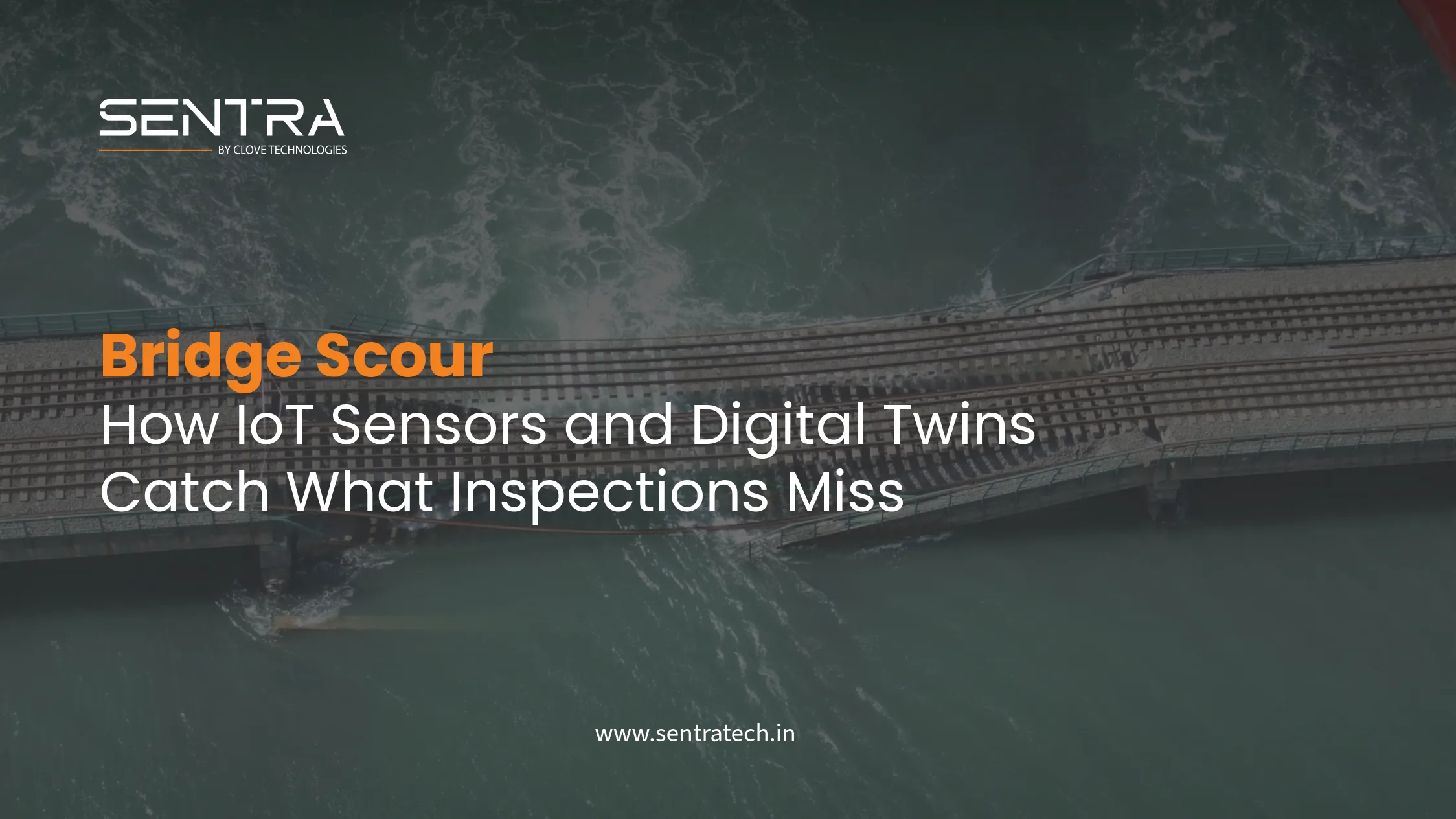
Scour, the erosion of riverbed material around bridge piers, is one of the leading causes of bridge failure worldwide. Underwater scour is invisible to visual inspection. Automated scour monitoring using sonar, tilt sensors, and flow velocity meters provides 24/7 awareness of foundation stability. Learn more in our detailed guide on bridge scour monitoring with IoT sensors and digital twins.
8. Fatigue Cracks in Steel Members
Repeated cyclic loading from heavy traffic initiates fatigue cracks in steel girders, welded connections, and orthotropic decks. These cracks often begin at the microscopic level and propagate undetected. Acoustic emission sensors and strain-based fatigue monitoring detect active crack growth in real time.
9. Abnormal Temperature or Environmental Response
Structures expand and contract with temperature. When a bridge exhibits unexpected response to thermal cycles, such as residual displacement after a temperature swing, it suggests restraint, binding, or internal damage. Integrated environmental monitoring correlates thermal data with structural behavior for comprehensive health assessment.
10. Increasing Maintenance Frequency or Repair Costs
If your maintenance logs show escalating repair frequency or costs for a particular bridge, it is likely experiencing progressive deterioration. Continuous monitoring replaces reactive repairs with predictive maintenance, reducing lifecycle costs and extending service life.
Protect Your Bridge Assets with Continuous Monitoring
Don't wait for the next visual inspection to discover a problem. Continuous structural health monitoring provides real-time awareness, reduces lifecycle costs, and ensures public safety. Contact Sentra Technologies today for a free consultation.
Contact us