
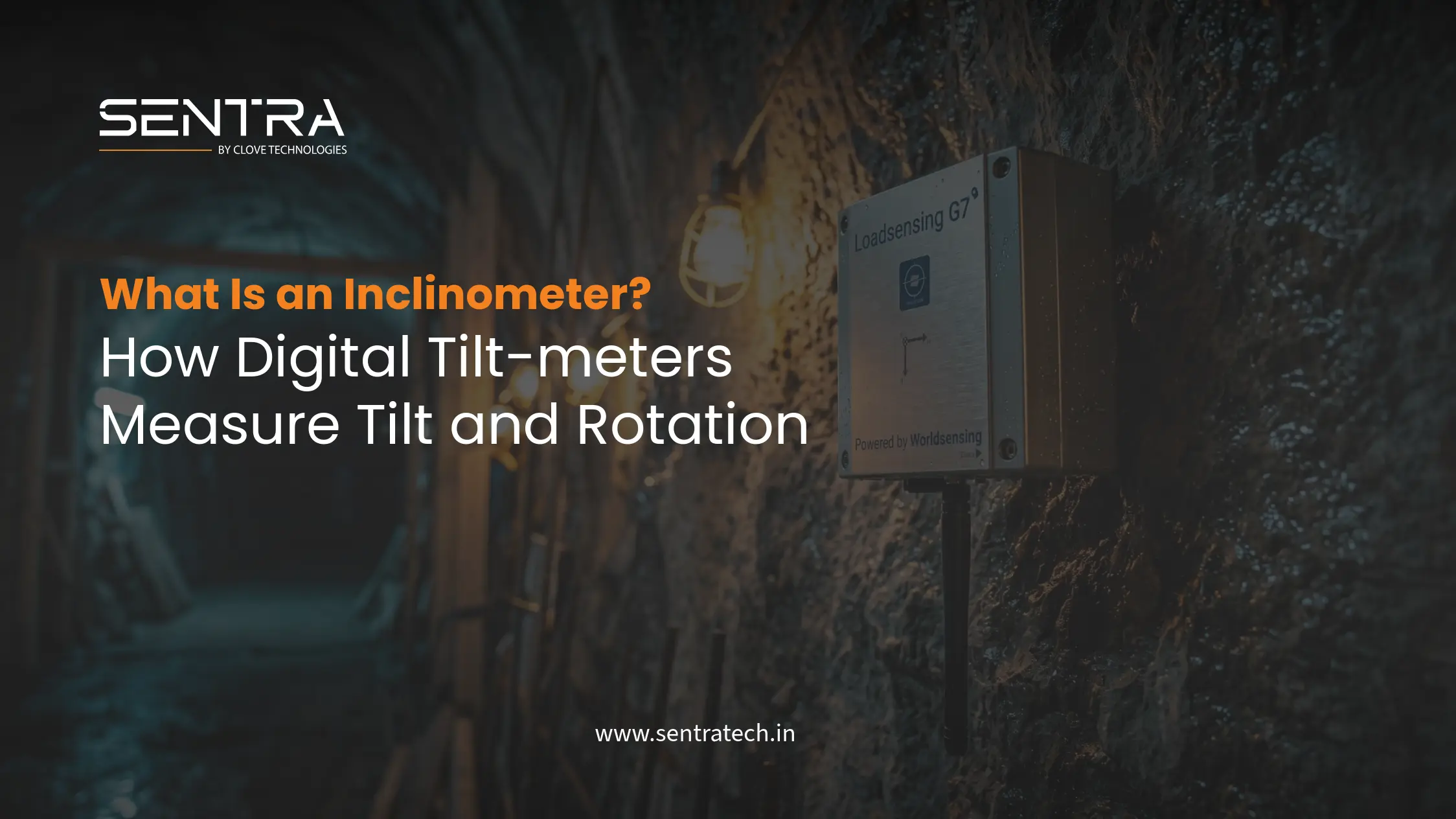
An inclinometer, also called a clinometer or tilt sensor, measures the angle of an object relative to the direction of gravity. It's one of the simplest ideas in sensing, angle in, number out, but in infrastructure and geotechnical monitoring it's also one of the most sensitive early indicators of trouble: slopes, retaining structures and foundations almost always tilt slightly before they fail visibly.
How a Digital Inclinometer Works
Modern digital inclinometers use a MEMS (micro-electromechanical systems) accelerometer: a microscopic mechanical structure on a silicon chip that responds to the constant pull of gravity. By measuring how that gravitational force is distributed across its axes, the sensor calculates its orientation with respect to level, typically across two or three axes for a complete picture of tilt in any direction.
Precision matters enormously here. Sentra's wireless tiltmeter, for example, resolves angular change down to ±0.0001°, far finer than anything visible to the eye, with integrated temperature compensation so thermal expansion of the mounting surface doesn't get mistaken for real movement.
Inclinometer vs Tiltmeter: Is There a Difference?
In practice the terms are used almost interchangeably, and most manufacturers, Sentra included, use them to describe the same underlying MEMS tilt-sensing technology. If there's a distinction, it's one of convention rather than physics: "inclinometer" is more often used for handheld or borehole survey instruments and general angle-measurement tools, while "tiltmeter" more often refers to a fixed, permanently installed sensor reporting continuously over months or years as part of a monitoring network. Search for either term and you'll find the same class of device.
Where Inclinometers Are Used
- Slope stability & landslide monitoring: detecting the early acceleration in ground movement that precedes a slope failure.
- Tunnel & excavation monitoring: tracking lining rotation and convergence during and after tunnelling works.
- Rail infrastructure: monitoring track cant and geometry, catching misalignment before it affects ride quality or safety.
- Dams & embankments: long-term crest and embankment deformation tracking for dam safety assurance.
- Buildings & bridges: foundation settlement, pier rotation, and overall structural inclination through construction and service life.
Choosing a Digital Inclinometer for Continuous Monitoring
A handheld inclinometer is fine for a one-off survey reading. Continuous infrastructure monitoring needs more: wireless reporting so data doesn't rely on someone visiting site, an IP68-rated enclosure that survives years outdoors, and battery life measured in years rather than days. Sentra's tiltmeters run on LoRaWAN with up to 10 years of unattended operation, and support triggered event detection, so a sudden movement generates an immediate alert instead of waiting for the next scheduled reading interval. To learn more about the logging hardware that captures and transmits tilt data, see our data logger guide.
Takeaway
Inclinometer and tiltmeter describe the same core technology: MEMS-based angle sensing referenced to gravity. The difference that actually matters for infrastructure owners is deployment, wireless, IP68-rated and built for years of unattended reporting, not the terminology.
Explore Sentra Wireless TiltmetersFrequently Asked Questions
A digital inclinometer uses a MEMS accelerometer to measure how the constant force of gravity is distributed across its sensing axes. That distribution is converted into a precise angle relative to level, with temperature compensation applied so thermal expansion of the mounting surface isn't mistaken for real tilt.
Digital inclinometers are used anywhere sustained or sudden angular movement is a safety or performance concern: slope stability and landslide monitoring, tunnel convergence, rail track geometry, dam and embankment deformation, and structural tilt on bridges and buildings.
High-precision MEMS inclinometers, such as Sentra's wireless tiltmeter, resolve angular change down to about ±0.0001°, with repeatability below 0.001° in the external-antenna variant, well beyond what's visible to the eye, which is what makes them useful for catching slow-developing structural issues early.
Yes. Slopes and embankments typically show a measurable increase in tilt rate before a visible failure occurs. Continuous inclinometer monitoring, especially with triggered event detection, can flag that acceleration in movement well before it would be caught by a routine site walkover.